
Columnist; Science and Academics

Millionaire for Life is the new multi-state draw game from the Multi-State Lottery Association with a top prize of $1,000,000 a year for life and a second prize of $100,000 a year for life. Tonight, at 11:15 p.m. ET, 31 states will participate in the first draw.
While it is true that this is a new and exciting multi-state game, mathematically, it is a simple lottery game with one daily draw and fixed prizes. It is structured similarly to Powerball, but with different parameters and no add-ons. In this second article in the series, we will examine and explain the statistical indicators and the math behind Millionaire for Life.
Category
Millionaire for Life is a combinatorial lottery game drawing from two pools: five numbers drawn from 1 to 58 (the base draw) and one number drawn from 1 to 5 (the Millionaire Ball).
- Size of the draw: 6 (5 + 1)
- Size of a played line: 6 (5 + 1)
- Cost of a line: $5
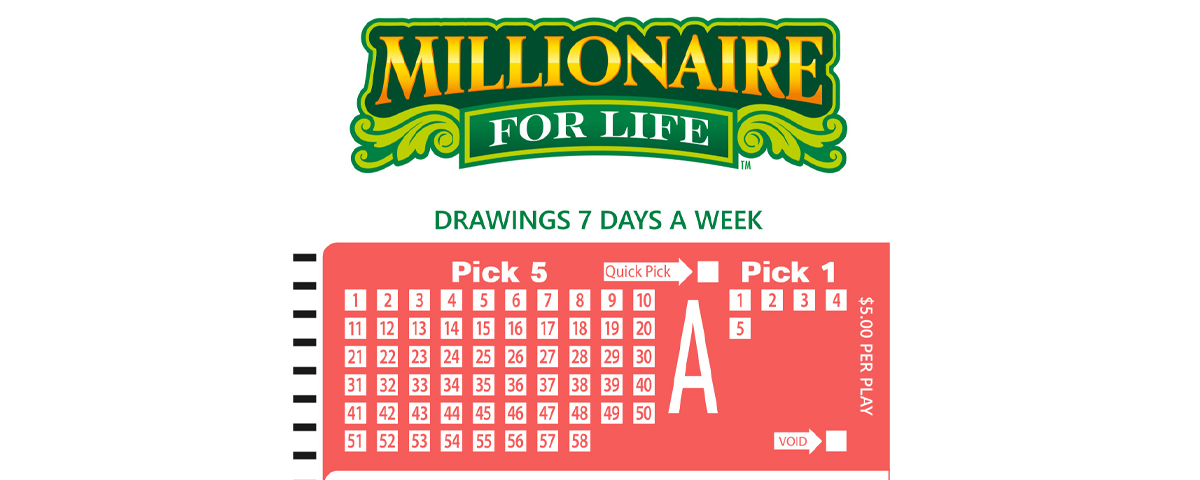
An example of a Millionaire for Life play slip. Photograph credit to the Arkansas Scholarship Lottery.
Prizes
There are nine tiers of prizes, similar to Powerball, defined by matching one to six numbers in the draw (including one for the Millionaire ball), with the only exception being matching only one number. All prize tiers have fixed values.
It is worth noting that the prizes do not increase uniformly from the lowest to the highest. There are some quite abrupt jumps: from the first tier to the second tier (from $18,000,000 to $2,200,000 as cash options), from the second tier to the third tier (from $2,200,000 to $7,500), and from the third tier to the fourth tier (from $7,500 to $500). This also applies to the corresponding odds of winning.
Odds of winning
The odds of winning range from 1 in 22,910,580 (for the 1st tier) to 1 in 15.65 (for the 9th tier, one of the highest odds of winning in the lottery games). The overall odds of winning a prize are 1 in 8.46 (again, one of the highest odds of winning across existing lottery games).
The odds of winning Millionaire for Life's top prize are about 13 times higher compared to the odds of winning the Powerball jackpot. This jump is, of course, due to the smaller number pools used in Millionaire for Life. The game draws from a pool with 11 fewer main numbers and 21 fewer extra ball numbers than Powerball.
For the second-tier prize, the odds of winning in Millionaire for Life are only about twice as high, while for the third-tier prize, they jump again to about 11 times higher.
Average win and fairness
The following table lists the average win for each prize:
| Prize tier | Prize amount | Average win |
|---|---|---|
|
5 + 1 match |
$18,000,000 cash |
$0.78566 |
|
5 match |
$2,200,000 cash |
$0.38410 |
|
4 + 1 match |
$7,500 |
$0.08675 |
|
4 match |
$500 |
$0.02313 |
|
3 + 1 match |
$250 |
$0.15036 |
|
3 match |
$50 |
$0.12029 |
|
2 + 1 match |
$25 |
$0.25562 |
|
2 + 0 match |
$8 |
$0.32719 |
|
1 + 1 match |
$8 |
$0.51118 |
The annuity option for the first and second prizes has not been considered in this table. Just as an exercise, a first-tier prize won and paid as an annuity for 40 years would result in an average win of $1.74591 (for a hypothetical player who continues to play regularly after that win).
Here is an example of how to interpret the table: Over the long run, a win in the 3 + 1 match tier is distributed as an average win of $0.15036 per line played, assuming the prize is won with the relative frequency of about 1 in 1,663 draws.
The table below lists the fairness of each prize relative to its probability:
| Prize tier | Prize amount | Fairness |
|---|---|---|
|
5 + 1 match |
$18,000,000 cash* |
39.30% |
|
5 match |
$2,200,000 cash* |
19.20% |
|
4 + 1 match |
$7,500 |
4.30% |
|
4 match |
$500 |
1.20% |
|
3 + 1 match |
$250 |
7.50% |
|
3 match |
$50 |
5.80% |
|
2 + 1 match |
$25 |
11.90% |
|
2 + 0 match |
$8 |
12.80% |
|
1 + 1 match |
$8 |
20.50% |
*The first and second tier prizes have been considered only in their cash option.
The highest fairness is associated with the first two prize tiers and the lowest tier. Surprisingly, the least fair prize in the prize schedule is the one for matching 4 of the main numbers, at only 1.20%. This means that if this prize tier had a similar fairness value to that of the other prize tiers, players would have deserved a higher prize than $500. Compared with Powerball, Millionaire for Life has overall far higher fairness, as reflected in its available prizes and its odds of winning.
Expected value and house edge
Since all Millionaire for Life prizes are fixed, we can compute the exact expected value.
If we consider the cash option for the first and second prizes, the expected value of the game would be –$2.355 for a $5 play, or –47.10% of the wager. The house edge in this case is 47.10%.
If we consider the annuity option for the first and second prizes, we need to make assumptions about the average age and lifetime of the winner to estimate the game's expected value. We took the average age of the winner to be 40 years and used the average lifetime in the U.S., which is 77 years. Under these assumptions (with a 4% discount rate of the annuity), the expected value would be –$3.160 for a $5 stake, or –63.20% of the stake. The house edge of the game is then 63.20%, higher than in the cash option case. However, such figures only reflect ideal mathematical conditions in a lottery experiment and are only partially relevant for winners who play regularly over their lifetimes.
Millionaire for Life has a lower house edge than Powerball when the latter is estimated with no jackpot won, but a higher one when compared against Powerball’s average jackpot over the last decade.
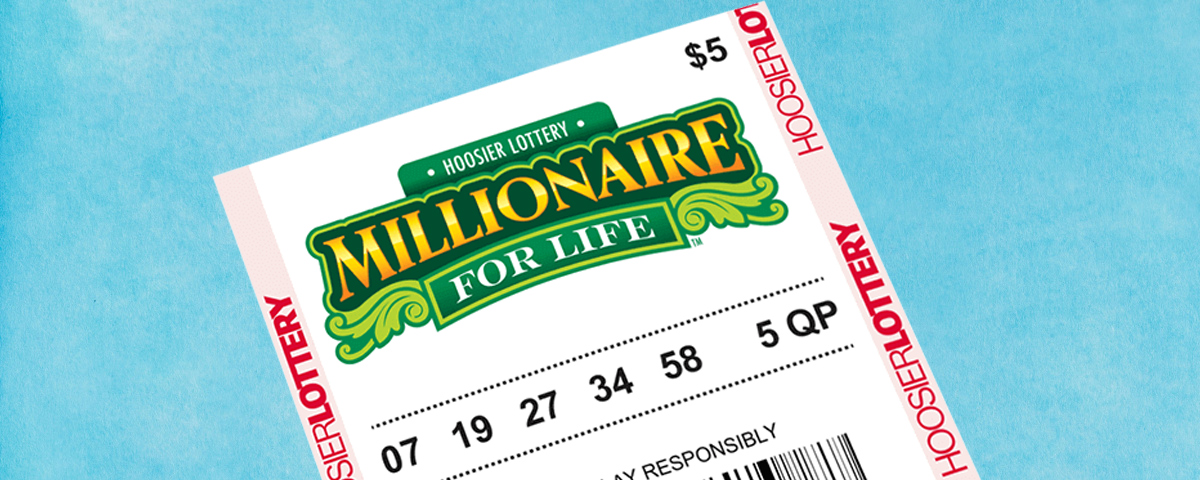 A sample Millionaire for Life ticket. Photograph credit to the Hoosier Lottery.
Final remarks
Millionaire for Life falls in the category of simple lottery games with “medium” odds of winning in the first two tiers (with order of magnitude from 1 in tens of millions to 1 in millions). The odds of winning are better, especially if you focus on prizes other than the jackpot. Additionally, the prizes following the first three tiers are higher than those in Powerball.
These advantages of the Millionaire for Life over Powerball come at the cost of a higher price for each line played ($5 compared to $2 or $3); however, in the long run, Millionaire for Life also has a lower house edge if we ignore the Powerball jackpot. This means that the cost criterion is only valid for short- to medium-run play.
The same argument stands for choosing between the cash and annuity options. While the cash option has a lower house edge, making it theoretically preferable to the player in the long run, the house edge criterion may become irrelevant depending on personal factors such as playing style, goals, and financial condition. At a theoretical level, a higher house edge for the annuity option just indicates that the lottery's advertised “for life” headline overstates economic value when discounted properly.
All of this means this game may be preferable to its big brother, Powerball, for players who plan to play often and are not only interested in chasing big jackpots.
Be sure to stay tuned for the next installment of our "The Math Behind" series, where we'll continue to delve into the numbers behind some of the most popular lottery games in the United States.















Comments